


The Hidden Cost of Flu Season: Why Delhi’s H1N1 surge is a Workplace Crisis
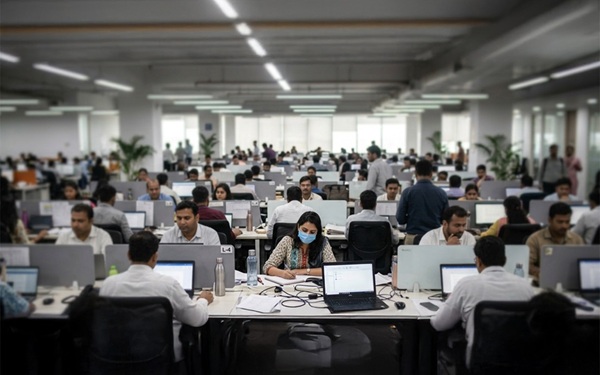

Delhi has reported over 3,000+ cases of H1N1 this flu season. That’s a sixfold increase from last year. While headlines frame this strictly as a medical story dominated by symptoms, treatments, and health advisories, they leave out an important side of the story: what happens inside the office building where millions of people spend most of their time.
This is not an isolated spike. India sees two seasonal flu peaks every year: one between January and March, and a second during the monsoon and post-monsoon months, roughly July through November. Each time, Indian businesses absorb a loss that never becomes a headline, because nobody puts a number on it.
The Actual Cost Nobody Counts
Once an employee is infected with the flu, they lose around 3.5 working days, including sick leave and reduced performance at work. Yet, only 30 to 37 percent of people infected actually took a day off work.
Most people do not stay home. Some cannot afford to use up their leave balance. Some do not think a cough and fever are worth staying home for. Either way, no official absence is recorded, but productivity drops, decisions are delayed, and deadlines are rescheduled.
Presenteeism is the bigger, longer-running problem, and it’s the one nobody measures. Being sick and staying home is a cost everyone already expects. But this gets missed every flu season: being sick and showing up anyway.
An employee who comes to work sick loses close to 2.5 hours of productive time a day. Recovery to baseline output can take more than 7 days longer than it takes an absent employee to bounce back once they’ve actually rested. Working through the illness doesn’t get anyone back to normal faster. It stretches the timeline.
That’s the cost to the sick employee alone. Now scale that to a floorplate of 500 people. One sick employee at a shared desk or a meeting room in a poorly ventilated office becomes a transmission risk. The risk spreads to everyone breathing the same recirculated air on that floor.
A second hidden cost has nothing to do with the employee being sick at all. On average, 50-75% of employed caregivers missed work to look after a household member with flu. That is lost output from people who were never infected, on top of everything already counted.
Adding it up: absenteeism, presenteeism, and caregiving leave together are the actual cost of flu season, while only one of those three is being tracked.
Where Modern Office Buildings Fail
During monsoon and post-monsoon months, central air conditioning runs at full capacity with sealed windows. The buildings are designed to look impressive: polished glass facades, sealed floor-to-ceiling windows, packed floors that never let in outside air. The design wins on looks but leaves the air nowhere to go. Recirculated air becomes the fastest route for a virus to travel from one desk to fifty others.
This is not only a virus problem. A Harvard study found cognitive scores were 61 percent higher on days when a building had good ventilation, and 101 percent higher when ventilation and air quality were both optimised. An under-ventilated office is a productivity problem even in a season with no flu circulating. During the flu season, it becomes a transmission problem too.
What Actually Works
This is where the standard response falls short. A stand-alone air purifier sitting in the corner of a conference room only cleans the air that passes through it, in that one room. It fails to treat the shared air moving through the central HVAC ducts connecting cabins, conference rooms, and open bays.
An effective solution requires intervention at the airflow source. In-duct air purification technologies, such as REME (Reflective Electromagnetic Energy) and Photohydroionization (PHI), treat air within the central AC system before it recirculates across workspaces. REME treats air before it ever recirculates. It works by turning the natural moisture in the air into a very low level of hydrogen peroxide vapor, the same trace compound already present in fresh outdoor air. That vapor travels through the ducts into every room the AC serves, attaches to bacteria and viruses on contact, and breaks them down at the source instead of waiting for them to pass through a filter.
Independent labs test these claims with a sneeze test: live pathogens are released into a sealed chamber (similar to what a sneeze would put into the air), the purification system runs, and then researchers measure how much of that pathogen is still floating in the air after a set time.
Kansas State University ran this test on PHI-CELL technology against H1N1 and recorded over 99% inactivation of the virus. CSIR-CCMB (Centre for Cellular and Molecular Biology) has validated that advanced in-duct systems reduce airborne viral loads (including Influenza A variants) by over 97% to 99% within 30 minutes under realistic environmental conditions.
Plan Before the Next Spike
Delhi is already in the middle of a flu season with case counts six times higher than last year. The next one will arrive in the same monsoon and post-monsoon window, and a reactive strategy will cost companies millions in lost productive hours. Before the next seasonal peak, start with an air audit. A professional indoor air audit identifies unventilated recirculation zones, tracks CO2 accumulation hotspots, and provides the baseline data needed to engineer an appropriate in-duct purification strategy.
O2Cure is an indoor air quality solutions provider offering engineered, customized air purification technologies for commercial and residential buildings across India.
To schedule a comprehensive indoor air quality audit for your facility, visit www.o2cure.in.